GOOOLLL
Articles
← All articles
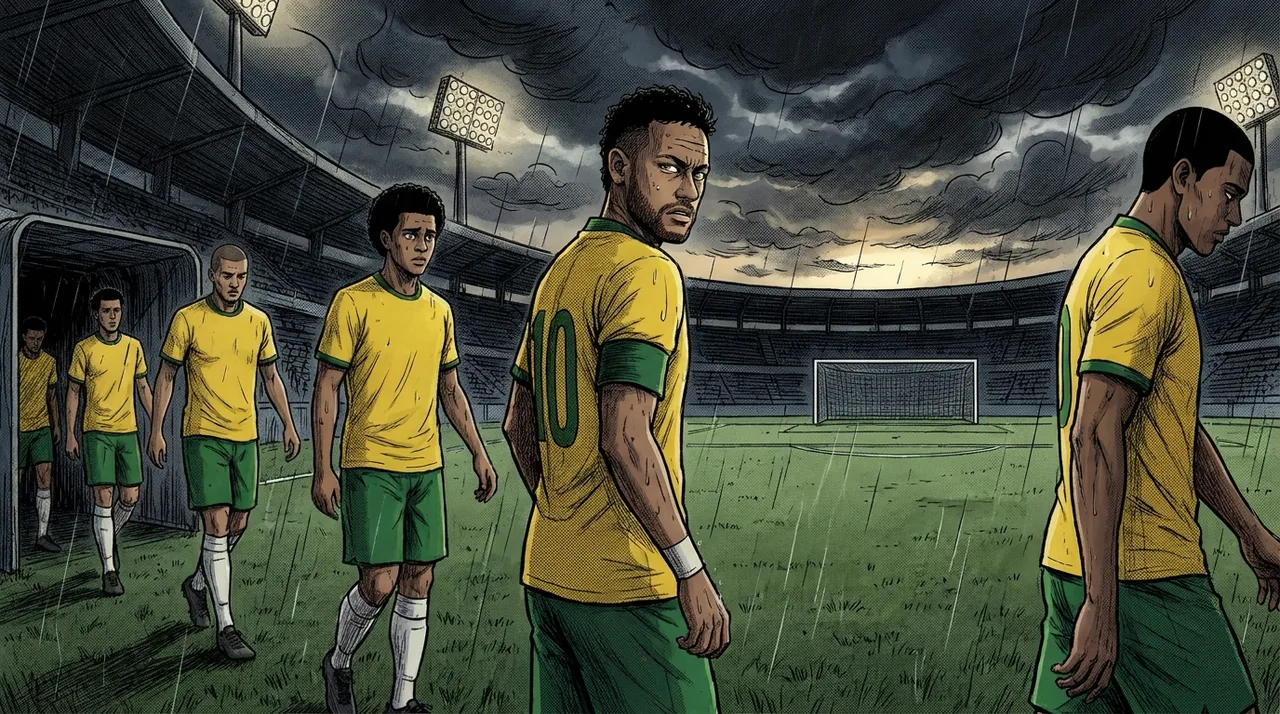
Brazil Top Group C. They Should Be More Worried Than They Look.
July 5, 2026
Gooolll Desk
Seven points. Top of Group C. A +6 goal difference that Morocco, level on points but trailing by three goals, couldn't match. On paper, Brazil's group stage reads like a coronation.
Watch the games back and it reads differently.
The numbers that matter aren't the ones Brazil's federation will be printing on press releases. They're the ones hiding in the final fifteen minutes of matches Brazil should have buried by the hour mark—the scrambled defensive shape, the fullbacks caught high, the centre-backs left to deal with transitions alone while the midfield was still admiring its own passing sequences. That's the film. That's the problem.
Morocco Already Told You
Morocco didn't beat Brazil in the group stage. But finishing level on seven points—separated only by goal difference—isn't nothing. It's a data point. Morocco pressed India into a 0-3 defeat running a compact, aggressive 4-3-3 that recycled the ball vertically before opponents had time to organize. Ismael Saibari scored three goals in that system, and not lucky ones. Transition goals. Exactly the kind Brazil's midfield construction invites.
Brazil's goals have come from Vinicius Junior, who leads the Brazilian contingent at the tournament with four, and Matheus Cunha with three. Both brilliant. Both, in context, doing the work of compensating for a midfield that doesn't protect them when the ball is lost. Clinical finishers covering up structural wobbles is a formula that wins group stages. It doesn't always win knockout rounds.
The Design Flaw Nobody Wants to Name
This isn't a talent problem. Brazil never really has talent problems. It's an instruction problem—a CBF instinct, almost cultural at this point, to overload the midfield with creative players who thrive when opposition lines sit deep and invite the ball. It's gorgeous when it works. When opponents press early and press hard, the fullbacks are suddenly exposed, the wingers are scrambling back to do defensive work they're not built for, and the whole elegant structure starts to buckle.
Argentina won Group D 3-2 in a game that showed exactly the kind of tactical nastiness the knockout stage will carry. Mexico hammered through Group A with nine points. Germany's six-point run through Group E was built on defensive organization first, attacking quality second. The 48-team format—deeper groups, more survivors, a wider spread of tactical sophistication—rewards the teams that are hard to break. Brazil, right now, is not hard to break. Not if you're brave enough and organized enough to press them.
What Needs to Change
The reshuffling isn't complicated in theory. Either you play a genuine double pivot—two sixes who sit, screen, and force opponents to build through midfield rather than around it—or you build a press trigger of your own, something proactive that puts the question back to the other team before they can ask it of you. Sitting in a midfield structure designed for slow build-up and hoping knockout opponents don't notice the gaps isn't a plan. It's optimism.
Brazil can still win this tournament. The attacking talent makes that genuinely possible, not just paper-talk possible. Vinicius Junior at this level is a problem nobody has fully solved. But there's a difference between winning *because* of your system and winning *in spite* of it, and right now Brazil is firmly in the second category. In a World Cup with 48 teams and no weak knockout draw, that distinction tends to come back and find you.
Any side from Groups A, D, E, or F that watched Brazil's last fifteen minutes on tape will have circled the date already.
gooolll