GOOOLLL
Articles
← All articles
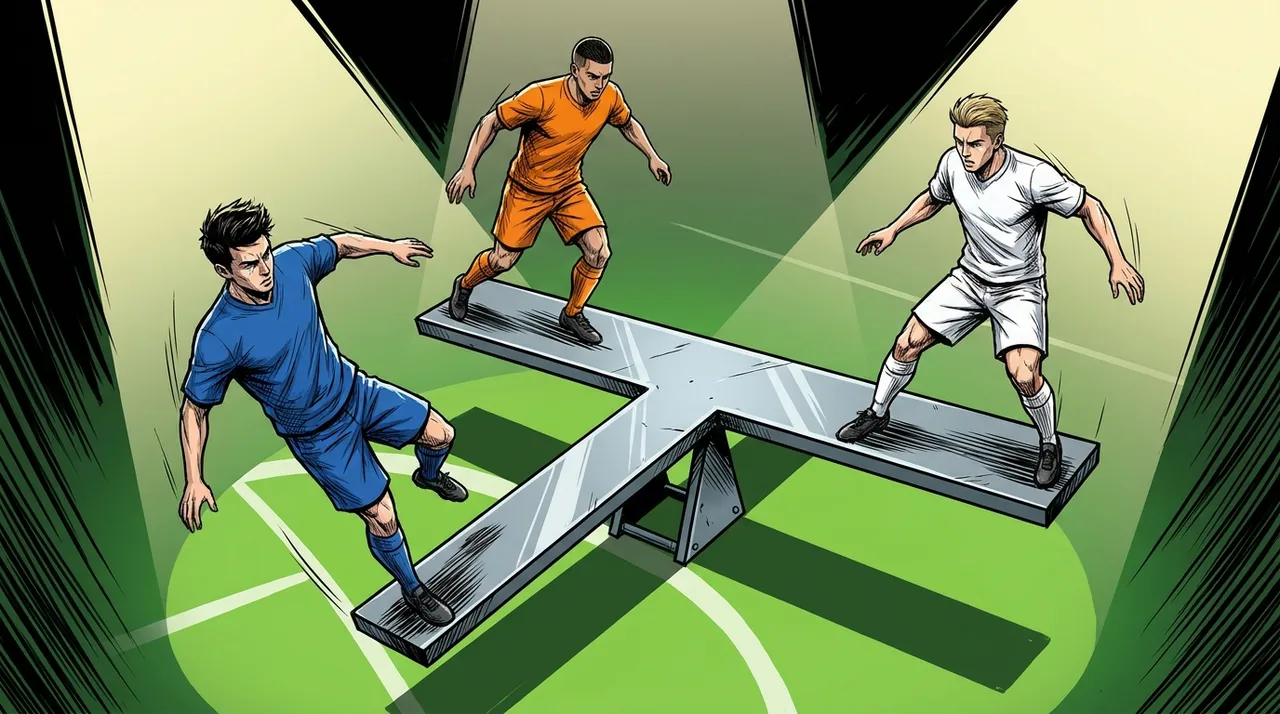
2026 World Cup Group Math: Why Second Place in a Brutal Three-Team Battle Beats Winning Soft
July 5, 2026
Gooolll Desk
Winning your group used to be the point. Not anymore.
The 2026 World Cup's expansion to 48 teams—twelve groups of three, sixteen spots in the knockouts—has quietly dismantled one of football's oldest assumptions. In this format, *how hard it was to get through* matters more than whether you came first.
The mathematics are genuinely strange. Four groups send both their top two teams through; so do the rest—but the points and goal differentials accumulated across wildly uneven groups create a situation where a runner-up who went toe-to-toe with elite opposition can leapfrog a group winner who feasted on minnows. It isn't a loophole. It's baked in.
Picture one group containing France—Kylian Mbappé and Ousmane Dembélé combining for 11 goals, Mbappé alone on 7—alongside a dangerous European side and a significantly weaker third team. Picture another group with no traditional powerhouse but a capable African or South American challenger holding it together. Second place in the first group, battered and bruised from two matches against a man in the form of his life, could carry a better record than the winner of the second. The credential of surviving Mbappé is worth something the bracket now quantifies.
Lionel Messi is also on 7 goals, Argentina having already played a 3-2 thriller that felt like a knockout match two rounds too early. Vinicius Junior and Matheus Cunha bring Brazil's attacking threat at 4 and 3 respectively. Ismaïla Sarr's 4 goals signal that Senegal arrive as a genuine complication rather than a scheduling convenience. Put any combination of those teams in one group and second place becomes a lottery ticket worth cashing. Third place is a flight home.
This is already reshaping how coaches think before a ball is kicked. Group draw analysis—always an art form wrapped in fake nonchalance—now carries real tactical weight. A manager might actively prefer finishing second against France and Senegal over winning a group of three opponents who tested nothing. The harder path, perversely, offers better preparation and sometimes a cleaner route through the draw.
The tactical consequences follow. A compact 5-3-2 against Mbappé, defending deep, hunting set-pieces—which have emerged as a recurring theme at this tournament—and playing for one opportunistic win rather than chasing a group title that carries no extra reward: that becomes a coherent strategy, not a surrender. You bank the second-place finish as a credential. You arrive at the knockouts having already dealt with elite pressing, elite technical quality, the kind of test three weaker opponents could never provide.
Brazil's fixture today, like Mexico's, will offer early evidence of how the stronger sides are approaching this. Do they rotate to protect legs and manage a three-game group, or do they attack relentlessly to lock up first place before the final matchday? The answer tells you how seriously each coaching staff has studied the bracket geometry—and how much they trust their squad depth to absorb the format's demands.
For anyone watching, the shift is both exciting and slightly disorienting. A 1-1 draw in a three-team group—like the recent Egypt fixture—stops being a near-miss and becomes a calculated position. Qualification difficulty, not a tally of wins, is now the most honest measure of whether a team is ready for what comes next.
The 2026 format doesn't just add more teams. It turns the group stage's underlying logic on its head.
gooolll